


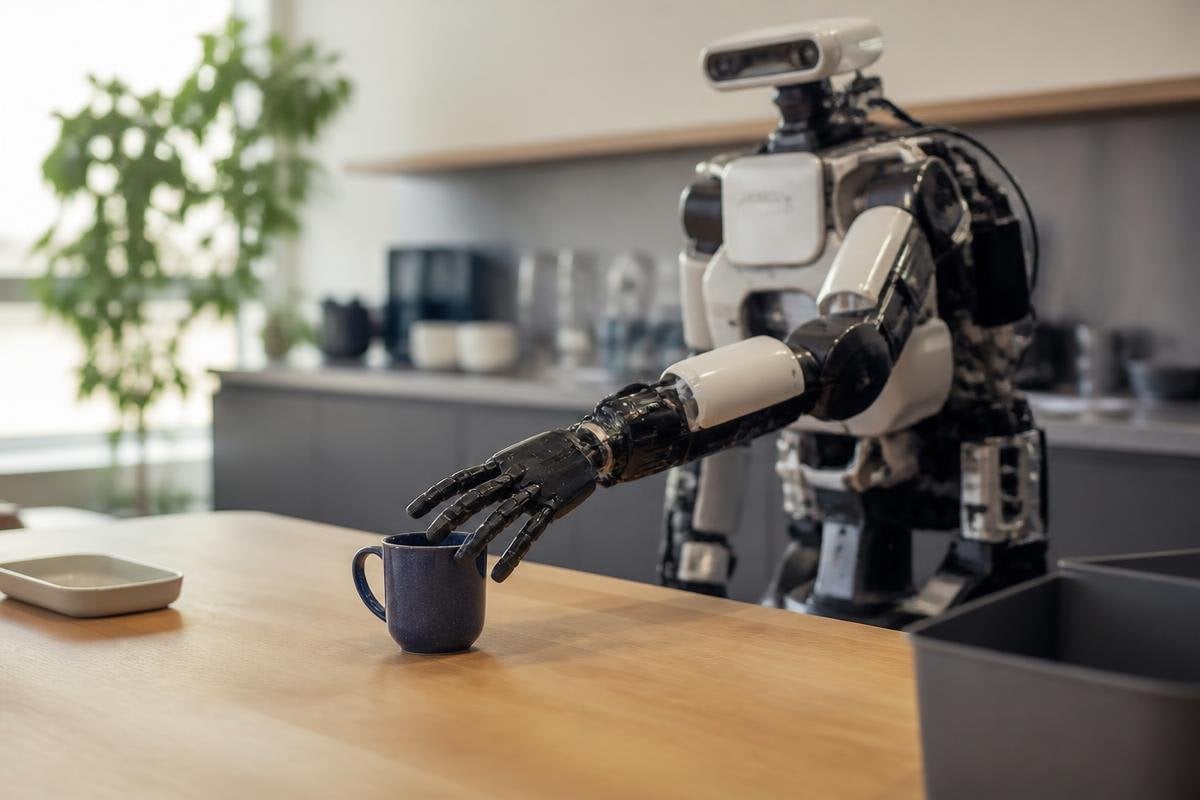
An AI model can describe a cup, but a robot must find it, reach it, lift it, and set it down without breaking anything. Embodied intelligence connects software decisions to sensors, motors, and the limits of a physical body.
Quick read
- A robot learns from what its sensors record and what its motors do.
- Physical mistakes cost time, power, parts, or safety.
- The open question is how much training a robot needs before it can handle new places and tasks.
What embodied intelligence means
A standard AI system works with data such as text, images, or recorded sound. An embodied system also receives live signals from the world and sends commands back into it.
That loop may include cameras, LiDAR, force sensors, wheel encoders, and joint position sensors. The model uses those inputs to choose an action, then checks what happened through fresh sensor data.
For example, the arm may close its gripper when an object is in reach, then adjust its force after the object starts to slip.
The body changes the problem. Software must account for weight, balance, motor torque, battery charge, surface grip, and the shape of nearby objects. A command that sounds correct can still fail because the arm cannot reach the shelf or the gripper cannot hold the box.
Why physical feedback matters
A language model can produce a useful answer without acting on the world. Physical systems have to deal with results. Its plan becomes useful only when the wheels move, the arm reaches the target, and the object ends up in the right place.
This feedback can help a system respond to changes that a fixed script does not cover. A box may sit at a different angle, a person may enter the work area, or the floor may have less grip than expected. The robot needs to sense the change and select a safe next move.
That does not mean the robot understands the world in the human sense. It means its software links perception, decisions, and movement closely enough to act under set conditions. The distinction matters when you assess a demo: a robot repeating a known motion has shown less than one that handles a changed setup.
A moved box or blocked path can expose limits that a fixed demo hides. Reports from Robot24 can tie claims about embodied intelligence to named robots, test settings, and what happened when the setup changed.
The work still left to do
Physical settings produce messy data. Lighting changes, objects hide one another, sensors drift, and contact with a surface can differ from one attempt to the next. A model trained in one room may need more training before it works in another.
Safety adds another limit. The system has to stop or change course when a person, tool, or loose cable enters its path. A system that performs a task well but reacts poorly to rare events is not ready for unsupervised work.
Cost matters too. More sensors and computing can improve what a robot detects, but they also add weight, power use, maintenance, and purchase cost. A system that needs a large computer beside each robot may fit a lab and fail the budget for a small factory.
The evidence gap is plain. Many projects can show a controlled task, but that does not prove reliable work across long shifts, new objects, or changing layouts. I’d treat embodied intelligence as a useful design direction, not a finished product category.
A practical way to judge a system
Use these checks when a company presents an embodied AI system or robot demo:
- Check the setting: Was the task run in one prepared room, or across several layouts?
- Watch the sensors: Can the robot react when an object moves, slips, or changes position?
- Count the failures: Does the report show failed attempts and recovery, or only successful runs?
- Measure the task: Look for cycle time, battery use, payload, and the number of human interventions.
- Ask about limits: Find out which objects, surfaces, lighting conditions, and safety rules the system cannot handle.
These details connect a software claim to work you can measure. They also show whether the system can fit a real process instead of a short demonstration.
Embodied intelligence may matter because robots face problems that data-only systems never have to solve: force, balance, timing, contact, and safety. The next useful proof is a robot that keeps working after the room, object, or task changes, with its failures and human support recorded.
